
I will be writing a paper proposal on the Baroque Period, how it came to be and how it evolve throughout its course specifically in Europe.
Posts
Final Project Outline/Background
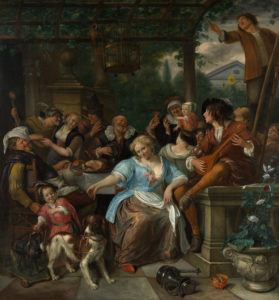
Jan Steen
Merry Company on a Terrace
Ca. 1670
Metropolitan Museum of Art

Attributed to the Master of the Martyrdom of St. Sebastian
Hercules and Achelous
Approx. mid-17th century
Metropolitan Museum of Art
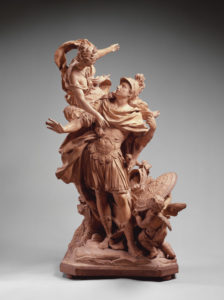
Jean Cornu
Venus Giving Arms to Aeneas
1704
Metropolitan Museum of Art
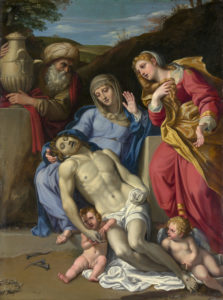
Domenichino
The Lamentation
1603
Metropolitan Museum of Art

Adriaen Brouwer
The Smokers
Ca. 1636
Metropolitan Museum of Art
Something that is noteworthy within all the artworks above is the exaggerations of the postures and facials expressions of the subjects used to covey drama and strong emotions within the viewer. The way the subjects are “moving” in the works makes for well-intended illustration of theatrical drama. In addition, the use of the contrast of light and dark color brings attention to the certain parts or characters. These key components are most prominent in the chosen artworks as well as the majority of Baroque art.
Paper Outline: Final Project
The Men-Centered Society & its Relationship to the Human Body
I. (1-2 Paragraphs) Thesis Statement: This paper will explore the development of the realistic and idealized human body as it coexists with the philosophy of Humanism; this artwork begins to exist because of the shift from a God-centered society, into a men-centered society. In other words, the Greek philosophy of humanism reformed society into a man’s world rather than a religious world. This paper will also attempt to explain the “regression” of the mimetic idealized human body during the resurgence of cult religions.
II. (Historical Influences: 2200-2152 B.C-5th Century):
A.The Old Kingdom Male Body:
Title: Statue of Tjeteti as a young man
Artist: Unknown
Museum: The MET
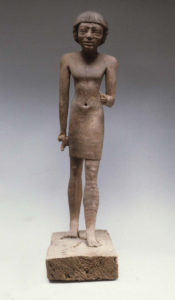
In the Old Kingdom, the artwork was much more abstracted, with larger eyes and hands. The body is not as emphasized; in other words, lacking muscles. They used the eyes and hands as religious symbols (supplication).
B. Archaic (6th B.C) Male Body:
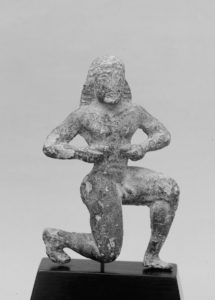
Title: Bronze youth
Artist: Unknown
Museum: The MET
C. The Classical Era (late 5th century B.C)
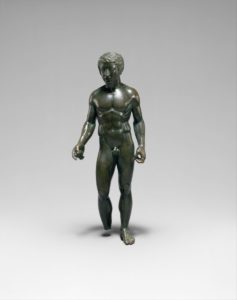
Title: Bronze youth
Artist: Unknown
Museum: The MET
Already from one century to the next the body becomes much more muscularized, and idealized. This shows the shift of a God-centered society into a humanism based civilization.
- The Met’s Heilbrunn Timeline of Art History, www.metmuseum.org/toah/ht/04/eusb.html.
“Following a period of sporadic incursions and large movements of people, demographic and economic changes in the eighth century B.C. lead to overseas colonization, spreading Greek language and culture across the Mediterranean and Black seas.”
This statement alone shows the development and inculcation of the Greek philosophy of humanism. This sculpture alone shows how this sporadic time inculcated this philosophy and in turn changed the image of the body by evolving into realistic pieces of artwork. The classical piece will show the further development of anatomical realism of the human body.
- Dr. Steven Zucker and Dr. Beth Harris, “Anavysos Kouros,” in Smarthistory, December 15, 2015, accessed December 10, 2018, https://smarthistory.org/anavysos-kouros/.
This is the most prominent piece of artwork that began the process into the realistic and idealized human body. The desire to improve began here or is widely known to have started with this art piece.
III. Hellenistic Period:
A. Early Hellenistic
Title: Terracotta relief probably from a funnel vase
Artist: Unknown
Period: Early Hellenistic; late 3rd–early 2nd century B.C
Museum: The MET
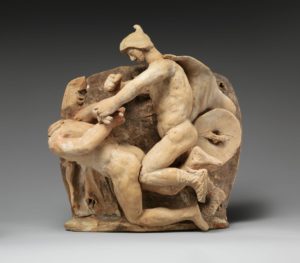
This statue also shows the importance of the body using two nude males, one most likely a Gaul and the other Greek, fighting. This fight combats the idea of the essence of Greek humanism; the struggle and dominance of man, especially the civilized greek.
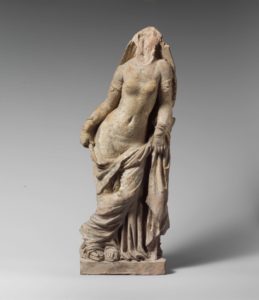
B. Hellenistic
Title: Terracotta statuette of a veiled woman
Artist: Unknown
Period: Hellenistic; 2nd century B.C.
Museum: The MET
IV. ca. 1000-1400
A. 1175-1200
Title: Virgin and Child in Majesty
Artist: Unknown
Period: ca. 1175–1200
Museum: The MET
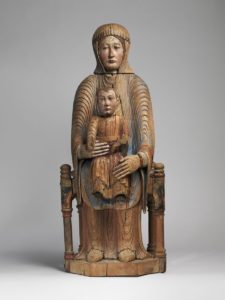
The shift of humanism towards a God shift society results in the abstracted form of the human body. Rather than alluding to the earthly, the heavenly is inferred through the abstract.
B. ca.1230
Title: Christ Enthroned
Artist: Unknown
Period: ca. 1230
Museum: The MET

This painting is to reiterate the shift religious status, resulting in abstracted human forms to allude to the heavenly. In other words when God is the center of civilization the body image is no longer realistic or idealized, but almost despised and forgotten.
- The Met’s Heilbrunn Timeline of Art History,
https://www.metmuseum.org/toah/ht/07/euwf.html
“Between 1000 and 1400, the kingdoms of the Franks, divided among many leaders, become the kingdom of France, which emerges under the Capetian dynasty as one of the most prosperous, powerful, and prestigious in Christendom.”
The change of religious state and political state influence the change of realistic and idealistic body images to an abstracted style, retracting to iconographic works similar to Egyptian worship statues. This alone proves that the philosophy returns to a God-centered society, where man is not as important in this time compared to the of the Greek democracy.
“The expansion of royal authority is halted in the fourteenth century by an economic crisis, the loss of a third of the population to the plague, and, from 1337, constant military conflict with the English”
Also interestingly enough, the return of the realistic and idealized body is after an economic crisis and the Bubonic plague. Men and women are suffering and because of this incomprehensible suffering, they become skeptical of a God. In other words when the need to return to a humanistic mentality arises the art changes with it. In short, when this need arises the Renaissance epoch began.
V. The Renaissance
A. Protestant Reformation
- Raphael M. Huber. (1941). Recent Important Literature regarding the Catholic Church during the Late Renaissance Period, 1500-1648. Church History, 10(1), 3-37. Retrieved from http://www.jstor.org/stable/3160724
The reason this article is so important because a common argument to my thesis would be:
During the Renaissance, Catholicism was very prominent, and yet the body image is highly idealized and realistic in the artwork. Well here is my point, the realistic and idealized body makes a comeback for two reasons; one is to give the Christian hope of heaven on earth; two, is because the church became extremely wealthy. The second point is important, the Protestant Reformation was because of the accusation that the Church’s distribution of wealth to create prominent and monumental Renaissance artwork was one of the many corruptions. Also, the use of the Catholic Hierarchy was another form of corruption. This hierarchy can be argued to be extremely narcissistic and places men in the middle of this societal circle once again; and not just any man but the Papal and clergy members. God was no longer in the center of this circle, but money was (money only serves man in order to survive).
B. Secular Government; Man-centered society
- Rule by Natural Reason: Late Medieval and early Renaissance conceptions of political corruption. (2012). In Barcham M., Hindess B., & Larmour P. (Eds.), Corruption: Expanding the Focus(pp. 53-72). ANU Press. Retrieved from http://www.jstor.org/stable/j.ctt24hbwc.8
“Conflict over lay investiture and the accompanying charges of simony (the act of buying or selling ecclesiastical benefices or emoluments) led Pope Gregory VII to declare sacerdotal and secular supremacy over all princely sovereignties.”
Simony, or like we spoke in class indulgences, were seen as a sign of corruption in the church. I also agree with this perspective because if the Pope and all clergyman have supreme sovereignty, then they no longer follow the belief of the church; Clergyman are a representation of Jesus Christ, and Jesus Christ was the last and servant of the lay people according to Catholic philosophy. Therefore this portrays the shift of a God-Centered society into a Man-centered society, where the Pope and Clergyman (who are men) make themselves Gods.
Works Cited
The Met’s Heilbrunn Timeline of Art History, www.metmuseum.org/toah/ht/04/eusb.html.
Dr. Steven Zucker and Dr. Beth Harris, “Anavysos Kouros,” in Smarthistory, December 15, 2015, accessed December 10, 2018, https://smarthistory.org/anavysos-kouros/.
The Met’s Heilbrunn Timeline of Art History
https://www.metmuseum.org/toah/ht/07/euwf.html
Raphael M. Huber. (1941). Recent Important Literature regarding the Catholic Church during the Late Renaissance Period, 1500-1648. Church History, 10(1), 3-37. Retrieved from http://www.jstor.org/stable/3160724
Rule by Natural Reason: Late Medieval and early Renaissance conceptions of political corruption. (2012). In Barcham M., Hindess B., & Larmour P. (Eds.), Corruption: Expanding the Focus(pp. 53-72). ANU Press. Retrieved from http://www.jstor.org/stable/j.ctt24hbwc.8
Annotated Bibliography
The Atlantic Monthly; August 1963; Letter from a Birmingham Jail; The Negro Is Your Brother; Volume 212, No. 2; pages 78 – 88.
This article was a letter written by Martin Luther King Jr. The letter discusses the urgency to have a nonviolent protest. He stresses the many reasons as to how important having a nonviolent protest would be. This article is useful to my topic because Martin Luther King Jr. is one of the pioneers who helped contributed to black people having the same rights as white people.
Bortolot, Alexander Ives. “The Transatlantic Slave Trade.” In Heilbrunn Timeline of Art History. New York: The Metropolitan Museum of Art, 2000–. http://www.metmuseum.org/toah/hd/slav/hd_slav.htm (October 2003)
This essay discussed about the transatlantic slave trade. It was an exchange mainly between Africa, Europe, and America. As America was forming they needed more laborers. Europe was constantly conquering and needed slaves as well. Slaves were brought through the Atlantic ocean from Africa to Europe to America. Black people had no say as to what they wanted to do. They were treated like objects and properties instead of human beings. This essay is related to my topic because it discussed the struggles that black people went through.
X, Malcolm. Malcolm X Speaks: Selected Speeches and Statements https://books.google.com/books?hl=en&lr=&id=ShfNyQrAa-YC&oi=fnd&pg=PR7&dq=malcolm+x+and+racism&ots=BA-eMqObLI&sig=SvyLqzvGHAAfy1IBpWq_o-Afua8#v=onepage&q=malcolm%20x%20and%20racism&f=false
This book by Malcolm X discuss some of the important speeches that he wrote. He discusses the involvement that he will be in regarding human rights for black people. He also discusses the meaning of a revolution. This book is relevant to my topic because Malcolm X helped black people gain the freedom and help preserve through the struggle even though it was in a violent way.
Clayton, Dewey M. “Black Lives Matter and the Civil Rights Movement: A Comparative Analysis of Two Social Movements in the United States.” Journal of Black Studies 49.5 (2018): 448-80. Web.
This article depicts a comparison between the Black Lives Matter Movement and the Civil Rights Movement. In the 1960s, African Americans were fighting to have racial equality as white people. In today’s time, African Americans are now fighting from police brutality against white police officers. In both movements black people had to fight and are still fighting to get the justice that they deserve as human beings. This article relates to my topic in that it talks about the struggles that black people have gone through and are still going through.
Davis Y., Angela. Women, Race, & Class https://books.google.com/books?hl=en&lr=&id=74QzFiv1w10C&oi=fnd&pg=PA30&dq=angela+davis+and+race&ots=HqEu78QMt0&sig=NOOdacGfAvIYXw89RgCC_Sac2vM#v=onepage&q=angela%20davis%20and%20race&f=false
This book discusses the Anti-Slavery movement and women. The anti-slavery movement is an abolishment society. Men who were free joined together to create this movement. White women eventually decided to join to show that they were more than just housewives. They wanted have rights just like black people. This is relevant to my topic because it discusses about African American hardships.

Annotated Bibliography
Dr. Renee M. Gondek, “Introduction to ancient Greek art,” in Smarthistory, August 14, 2016, accessed December 9, 2018, https://smarthistory.org/greek_intro/.
-This source by Dr. Renee M. Gondek describes an introduction to ancient Green art while going in depth on language, religion, and culture of different time periods. This can be useful for my project and proposed thesis statement because Gondek talks about the introduction of Greek art in the Archaic period with the stand still statue of Kouros.
Dr. Bryan Zygmont, “Hiram Powers, The Greek Slave,” in Smarthistory, January 24, 2018, https://smarthistory.org/hiram-power-greek-slave/.
-This source by Dr. Bryan Zygmont is about the story and origin of the Greek Slave and how it became a well known sculpture. This can be useful for my project because it provides a deep analysis of the sculpture itself as well as Hiram Powers’ (the artist) meaning behind the features of The Greek Slave. Through defining the female nude of the slave, I would be able to further argue my thesis of how Greek and Roman art used the human body to tell a story and symbolize beauty through experience.
Dr. Beth Harris and Dr. Steven Zucker, “Marble statue of a kouros (New York Kouros),” in Smarthistory, December 20, 2015, accessed December 9, 2018, https://smarthistory.org/marble-statue-of-a-kouros-new-york-kouros/.
-This source by Dr. Beth Harris and Dr. Steven Zucker provides two videos on the Kouros itself. This is simply an all about video on the Kouros and what each feature of the stand still sculpture represents. This is helpful for my project because it offers descriptions on the kouros and what the body represents. This relates to my thesis on why the human body was used in Greek and Roman art.
Gisela M. A. Richter. “The Greek Kouros in the Metropolitan Museum of Art.” The Journal of Hellenic Studies, vol. 53, 1933, pp. 51–53. JSTOR, JSTOR, www.jstor.org/stable/627245.
-This scholarly article by Gisela M. A. Richter is about the Kouros in The Metropolitan Museum. This article provides the significance of the statue of Kouros as well as information on the preservation of the Kouros and how it made its way into The Metropolitan Museum. This article is useful because it provides information on the Kouros and what the human body symbolizes in the statue.
Mattingly, Harold. “THE REIGNS OF TREBONIANUS GALLUS AND VOLUSIAN AND OF AEMILIAN.” The Numismatic Chronicle and Journal of the Royal Numismatic Society, vol. 6, no. 1/2, 1946, pp. 36–46. JSTOR, JSTOR, www.jstor.org/stable/42661251.
-This scholarly article by Harold Mattingly is about the reigns of emperor Trebonianus Gallus. This article offers a brief history on the reigns of Trebonianus Gallus. This can be useful for my project because I can use his experiences to describe why the sculpture is the way it is.
Final Project: Comparing Ancient artwork
Introduction: The different techniques and time periods of all forms of art have greatly impacted the presentation of the artwork. Although all three portray statues the way that these statues are articulated have created a line of differentiation amongst the two. Ancient Egyptian, Ancient Roman and Ancient Greek artwork symbolize the different roles played in society during the coinciding time periods. In museums and pictures the statues display character and a certain poise while the three illustrate different aspects of the given time frames and the different societies. Although the three forms of art hold similarities, they differ in many ways. Ancient Greek artwork is significant in articulating human like statues. They used human forms to display god like statues and display the traits of a dominating human. Ancient Roman artwork is significant for displaying different forms of art using marble, stone, glass, metal, etc. Ancient Egyptian artwork is significant in portraying the image of gods. Ancient Egyptian artwork was surrounded by religion and the afterlife. They would fill tombs of Pharaohs with scriptures and paintings for their afterlife. The sculptures created during this time period mainly displayed the image of Pharaohs who were considered gods during that time period.

Statue of Aphrodite
Artist: Unknown/ Purchase, 1952
Date: 1st or 2nd Century A.D
Museum: Metropolitan Museum
In this statue Aphrodite the Goddess of love is shown surprised while taking a bath, with her arm extending to cover her breast in a phase, which both hides and reveals her sexuality. This was not surprisingly a huge deal for the Greeks. Aphrodite is the goddess of love, desire and beauty and the daughter of Zeus. This statue of the Goddess represented a celebration of the female body in an ideal form of beauty, proportion, and grace. This was one of many different nude Greek female figures we saw at the MET but this one stood out a lot more than the rest. As a class we have discussed Aphrodite in many of the text we read throughout this semester, including the Iliad and odyssey of Homer.
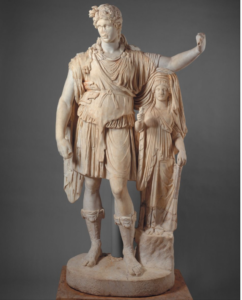
Statue of Dionysos
Artist: Pacetti, Vincenzo
Date:27 B.C.–A.D. 68
Museum: Metropolitan Museum
In this figure of Dionysos he is appeared to us standing with his left arm over on an archaistic female figure identified as Spes, the personification of hope. He is shown wearing a panther skin over his chiton and a cloak wrapped around his upper right arm and shoulder. The panther skin was a great symbol to identify this God just like wine would have been. In order for a support a part of the cloak flows around the back and over the head of the God. Another Greek female figure stands in front of the God of wine with her feet together on the base, while holding the lower part of her dress to one side. After understanding the figure’s costume, hairstyle, and explicitly her pose it persuades us that it’s a representation of Spes, a Roman personification of hope. Rather than the Text the God Dionysos was essentially discussed in the lectures that took place in class.
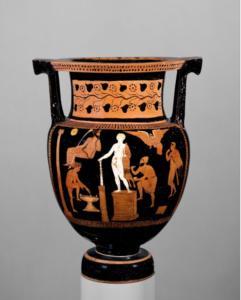
Terracotta Column- Krater
Artist: Group of Boston
Date: 360–350 B.C.
Museum: Metropolitan Museum
This Greek vase in orange and black caught my attention right away, because we had seen similar images in the Power point discussions in class. The paintings on the Vase portray a Styr waiting for Dionysos, the God of wine with a jug and jar, where you can assume it had something to do with the Styr wanting wine while on the other side another Styr uses gestures to express abandons.
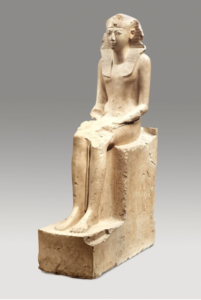
The Seated Statue of Hatshepsut
Artist: Unknown/ Rogers Fund, 1929
Date: 1479–1458 B.C.
Museum: Metropolitan Museum
This a limestone statue that honors Pharaoh Hatshepsut during her joint reign of power with Thutmose III, which was made around 1479-1458 BCE. The statue shows Hatshepsut seated, showing that she was a woman of power and authority. She is also wearing a headdress that only pharaohs and royal people wore. The statue is not naturalistic because of the awkward position that Hatshepsut is shown in, which is very common for ancient societies such as the Babylonian and the Egyptian. The pharaoh has an unnatural and stiff face and body and is not a way to depict the pharaoh. We can see that the pharaoh shows evidence of being a female because of the breasts and because of her long legs. The statue shows evidence of being damaged because the statue is not fully intact. The lower part of the right arm is missing as well as the left hand. The information also indicates that the statue was fragmented and had to be reassembled. The upper body was were excavated in fragments and the lower body was in another museum. Across the sides of the pharaoh’s seat are hieroglyphics which probably tell the story of Hatshepsut. This form of writing is used as a way to write down the story and life of the person, which is another method used by the Egyptians.
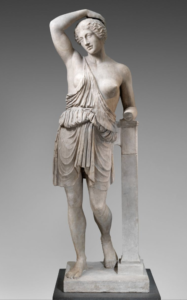
Marble Statue of a Wounded Amazon
Artist: Unknown/ Gift of John D. Rockefeller Jr., 1932
Date: 1st–2nd century A.D.
Museum: Metropolitan Museum
This is a Roman statue created in between 1-2nd century CE, and is a copy of a Greek bronze statue from 450-425 B.C. The statue shows the mythical race of Amazonian women who would battle against heroes such as Achilles. The statue shows a wounded warrior standing in a naturalistic way. The use of contrapposto is present, a Greek creation, which tries to show the shift of weight onto one foot. The body of the warrior is expressed more by showing the warrior’s body, specifically breasts. The warrior is wounded under her right breast and also there is evidence of multiple scars on the back that show that she is a warrior. The facial features are detailed and realistic, but the facial expression is not expressive which indicates the acceptance of death. The warrior’s right hand is wrapped around her head indicating that she is not in pain or struggling, which further indicates that she has accepted death. The warrior is wearing her fighting clothing which openly show her body, indicating that this was considered common in her culture.
Conclusion: Although these time periods have presented various forms of art, their artwork displays numerous similarities. They all display human like figures and are all presented in sculptures. The eyes, nose and certain physical features amongst all three: Ancient Greek, Ancient Roman and Ancient Egyptian art show distinctive traits as a human being. All three artworks display a dominant structure that essentially displays power and a higher or stronger being. The differences amongst all three artworks are clearly shown through the different sculptures. Ancient Egyptian artwork revolves around the representation of god or a high power. Which was displayed through Pharaohs. Ancient Roman artwork revolved around the illustration of sculptures that were presented in different materials such as bronze, marble, glass, metal and stone. Ancient Greek sculptures show a dominant male who has feminine characteristics and is shown having a muscular image. Ancient Greek sculptures relate to how a human being looks, they show a feminine side by allowing the sculptures to show a slight slouch or a soft knee bend, etc.
Sources:
http://history-world.org/arthist.htm
This article talks about the differences between Ancient Greek and Ancient Roman artwork. This article presents the similarities and differences amongst the two.
https://www.jstor.org/stable/985469?seq=1#page_scan_tab_contents
This article talks about the differences between Ancient Greek and Ancient Egyptian artwork. This article elaborates on different techniques used during each time period.
This article compares Ancient Roman and Ancient Egyptian artwork. It weighs in on the different music, sculptures and paintings that were idolized during that time period.
https://www.history.com/topics/ancient-history/ancient-greek-art
This article weighs in on the significant pieces of art produced during the Ancient Greek time period. This article shows images of the most popular sculptures made during the time period and elaborates on the techniques used to produce this artwork.
This article elaborates on the most popular art work produced during the Ancient Egyptian period of time. This article explains the importance of the ancient pyramids and the meaning behind the coffins.
Extra Credit
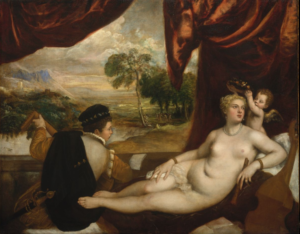
The painting that captured my attention at first sight was the canvas painting of Venus and the Lute player. Tiziano Vecellio, better known as, Titian created this painting during 1560. The setting of Titian’s painting focuses on three figures, the Greek goddess Venus, her love child Cupid, and a Lute player, in a setting showing a room that has lavish curtains and overlooks a landscape. I was attracted to Titian’s Venus because of my admiration of the Goddess Venus in my previous studies of Greek mythology. Venus also known as Aphrodite was the goddess of love, beauty and sex. In this painting, Titian portrayed Venus as a sensual and angelic woman, who has the ability to capture the viewers’ attention with her intense expressions. The painting depicts a nude Venus seated on a coach in a sensual position. She is wearing a white pearl necklace and expensive earrings. In the painting one can only see the profile of her face, which has an intense and subdued expression. Behind Venus is her son Cupid, who has a smaller figure and is holding a crown made of flowers over Venus’ head. The lute player is an important figure in this portrait because he is seen looking at Venus and it appears that he is playing music with his instrument. Behind the figures there is a window that overlooks a landscape, which consists of green trees, grass, and mountains. According to the gallery label, the painting has been thought to “address the Neo-Platonic debate of seeing versus hearing as the primary means for perceiving beauty.” My interpretation of the general theme or purpose of this canvas painting is its portrayal of the love for beauty and music. I hindered upon this theme based on the idea that artists from this time period idealized the female body as that of beauty. According to the Metropolitan Museum, the figures of a nude Venus “highlight the seductive warmth of the female body rather than its ideal geometry.” Like many artists from the Italian Renaissance, Titian represented Venus nude in order to symbolize the female body, thereby, representing beauty. On the other hand, the lute player is an abstract figure that is assumed to signify the love or admiration of music.
Bibliography
Citation: Timeline of Art History
https://www.metmuseum.org/toah/ht/04/eusb.html
“Following a period of sporadic incursions and large movements of people, demographic and economic changes in the eighth century B.C. lead to overseas colonization, spreading Greek language and culture across the Mediterranean and Black seas.”
This statement alone shows the development and inculcation of the Greek philosophy of humanism. This sculpture alone shows how this sporadic time inculcated this philosophy and in turn changed the image of the body by evolving into realistic pieces of artwork.
Citation: Timeline of Art History
https://www.metmuseum.org/toah/ht/07/euwf.html
“Between 1000 and 1400, the kingdoms of the Franks, divided among many leaders, become the kingdom of France, which emerges under the Capetian dynasty as one of the most prosperous, powerful, and prestigious in Christendom.”
The change of religious state and political state influence the change of realistic and idealistic body images to an abstracted style, retracting to iconographic works similar to Egyptian worship statues. This alone proves that the philosophy returns to a God-centered society, where man is not as important in this time compared to the of the Greek democracy.
Citation: Protestant Reformation
Raphael M. Huber. (1941). Recent Important Literature regarding the Catholic Church during the Late Renaissance Period, 1500-1648. Church History, 10(1), 3-37. Retrieved from http://www.jstor.org/stable/3160724
The reason this article is so important because it speaks of the protestant reform during the Renaissance that can be used against my argument.
Citation: Secular Government; Man-centered society
Rule by Natural Reason: Late Medieval and early Renaissance conceptions of political corruption. (2012). In Barcham M., Hindess B., & Larmour P. (Eds.), Corruption: Expanding the Focus(pp. 53-72). ANU Press. Retrieved from http://www.jstor.org/stable/j.ctt24hbwc.8
“Conflict over lay investiture and the accompanying charges of simony (the act of buying or selling ecclesiastical benefices or emoluments) led Pope Gregory VII to declare sacerdotal and secular supremacy over all princely sovereignties.” In other words, an argument for a man-centered society rather than God-centered is found in this article.
Citation: Smarthistory.org/anavysos-kouros/
Dr. Steven Zucker and Dr. Beth Harris, “Anavysos Kouros,” in Smarthistory, December 15, 2015, accessed December 10, 2018, https://smarthistory.org/anavysos-kouros/.
This is the most prominent piece of artwork that began the process into the realistic and idealized human body. The desire to improve began here or is widely known to have started with this art piece.

ARTD 1010 Final Project: Religious Altarpieces Paper Proposal
Religious Altarpieces and their significance to followers
Introduction:
I am looking specifically these art pieces because they relate to my topic of art with religious symbolism. This is also why they are all religious altarpieces. Christian followers have prayed to these pieces so they are guaranteed to have significant religious importance. They were objects of worship in churches and possibly in homes that represented the people’s faith in God. This strong devotion can be seen in the religious symbolism of the artwork. And some of these altarpieces are also built in a way that it surrounds you because they are large in size to create a sense of awe. I mainly want to look at the religious references like how a devoted christian would see it in an scholarly point of view. Why did they see these as important parts of their lives?
-Lorenzo Monaco, The Nativity, 1406-1410
Location: The Met
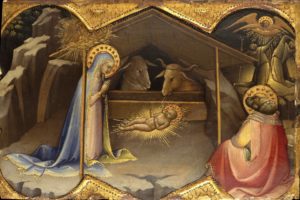
This is a painting made by Lorenzo Monaco between 1406-1410, titled “The Nativity”. It’s dimensions are 9 in by 12 in. There are 3 main figures in the painting. The Christ child is the center of attention, the virgin that is kneeling to the left adoring the Christ child she came birth to while the sun is above her head, and saint Joseph in the right looking up to the vision of the angel announcing to the Shepherd in the up right corner. Behind the Christ child is an Ox and a Donkey looking down on it. The virgin, saint Joseph, the angles and Christ child are represented as divine because they have visible golden halos. But Christ child and the angels are showing more divinity because they are emitting golden rays of light from their bodies. This includes the sun that will obviously emit rays of light. Their importance is even more accentuated by the contrast of the bright divine figures lighting up the dark backdrop. This can be seen as telling people that God’s light will make things clear and show you the path towards clarity. I chose this painting because it is an religious Altarpiece like all the other works below. I also chose this because it is symbolic of the devotion followers have for Christian divinity.
Source: The Met’s Heilbrunn Timeline of Art History, www.metmuseum.org/art/collection/search/459007.
-Robert Campin, Merode Altarpiece, 1425
Location: The Met
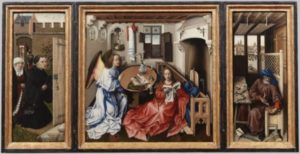
Merode Altarpiece was made in 1432 in the workshop of Robert Campin. It is also known as “Annunciation Triptych”. It’s dimensions are 2 ft by 4 ft. The painting depicts the archangel Gabriel Virgin announcing to Virgin Mary that she will give birth to Jesus Christ in a house that looks to be from Northern Europe in the 1400’s even though this scene would have fallen place 1500 years before the painting was made. This biblical event takes place in a typical high class household to make these figures feel closer to followers, making prayers feel more profound and closer to God. This painting is also dense with objects that have symbolic meaning. Much of it has been lost but there are a few items that are clear. The shiny pot in the back represents the Virgin Mary’s purity and sinlessness. There is a small figure holding a cross gliding towards the the Virgin, representing the Holy Spirit that will make the Virgin pregnant with Christ. When Christ is born, it’s when one world ends and another begins. In this world it’s possible for human beings to be saved because Jesus died on the cross for everyone’s sins. I chose this painting because it potentially holds large amounts of religious symbolism with its many objects in view and its purpose was to make you feel close to God when you pray to the altarpiece.
Source: Harris, Beth and Zucker, Steven. Workshop of Campin, Annunciation Triptych (Merode Altarpiece). YouTube, commentary by Dr. Beth Harris and Dr. Steven Zucker. 4 Feb. 2016, https://www.youtube.com/watch?v=q1X0Lj7YEMs&t=607s
-Jan van Eyck, Ghent Altarpiece, 1432
Location: Saint Bavo Cathedral
This altarpiece is very large and definitely creates a sense of awe when opened up fully. Even when closed, it is a large painting that is to be admired. It is truly a religious altarpiece of the highest caliber. When fully opened, it is 11ft by 15 ft, and when closed, it is 11 ft by 7.5 ft. This is essentially 2 painting in one piece of artwork. It most likely stayed closed most of the year and opened up on feast days as a revelation.
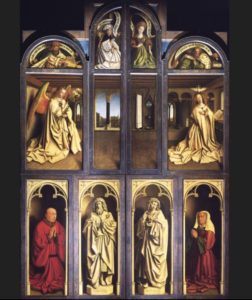
When closed, it shows 8 paintings in total. The 4 at the top shows the prophets and sybils predicting the coming of Christ. Below them is the actual event of the coming of Christ where archangel Gabriel is on the far left panel is announcing to Virgin Mary on the far right panel that she will give birth to Christ, the same scene depicted in the Merode Altarpiece. Gabriel is holding white lilies that represent Mary’s purity and virginity. There are actual words coming out of her mouth from writing on the painting in Latin where she says “Hail Mary, full of grace, blessed art thou among women”. Mary also has words coming out of her mouth with a dove above her head which represents the Holy Spirit. She replies “Behold the handmaiden of the lord”. The difference is that it’s backwards and upside down because she is replying “back”. Although these 4 panels show a high degree of realism, these words stick up in golden lettering, making them ethereal and speaks to God. The 4 panels below show 4 figures, 2 being the patrons that commission the piece and two sculptures that are the 2 Saint John.
Source: Harris, Beth and Zucker, Steven. Van Eyck, Altarpiece (1 of 2). YouTube, commentary by Dr. Beth Harris and Dr. Steven Zucker. 4 Nov. 2013, https://www.youtube.com/watch?v=udgNvPpDb2I
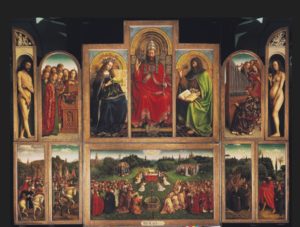
When opened up, you’re overwhelmed with a wall of colors. First thing you see is a large figure in the center depicting of God the father dressed like a king with a gold jeweled papal crown on his head and a gold jeweled crown at his feet to show that he is the king of kings. He also has a scepter that has a clear crystal handle and embellished in gold to represent power. The running theme is God’s saving grace and power, depicting his plan to forgive and redeem mankind. On the left of him is Mary, looking like a queen wearing a crown and on the right of him is Saint John the Baptist. Another symbol of his forgiveness is a pelican, which in the medieval tradition, it was believed that when it’s young was starving, it would pick at it’s flesh to feed them. Representing the sacrifice of God to save humanity. One panel further out is angels singing and playing instruments in heaven. And on the farthest left and right are Adam and Eve naked. They look deeply human and imperfect compared to the other figures mentioned, which can be reflecting God’s willingness to reach out to humanity despite imperfections. Directly below God is an image of 4 groups of people looking towards the scene in the center where a lamb is on an altar. The lamb has a wound on its side where it is pouring out blood into a chalice, representing Christ’s sacrifice. This is because the lamb is shown to be calm and serene with rays of light extending out of it’s head, overcoming earthy pain/suffering. Surrounding the lamb are angels carrying the torture instruments inflicted on Christ to create a sense of sacrifice for the redemption of mankind. These two set of paintings tell a story of Christ and how God has forgiven mankind for its sins through religious symbolism, showing intense devotion to Christianity, creating a sense of awe and pride to be a follower of God.
Source: Harris, Beth and Zucker, Steven. Van Eyck, Altarpiece (2 of 2). YouTube, commentary by Dr. Beth Harris and Dr. Steven Zucker. 10 Nov. 2013, https://www.youtube.com/watch?v=JVhwinCiELI
Conclusion:
These altarpieces are have clear religious significance when looking at religious symbolism represented in the art. All depicting the birth of Christ and Virgin Mary’s importance. The Nativity by Lorenzo Monaco depicts the moment Christ was born, the Merode Altarpiece depicts the announcement to Virgin Mary that she will have the Christ child, and the Ghent Altarpiece depicts the announcement to Virgin Mary and a dense amount of religious symbolism that tells the story of Jesus Christ’s and God’s sacrifice to mankind. The dense symbolism and constant appearance of Mary and Christ tells me that the birth of Christ is seen as the beginning of a world where humans can be forgiven for their sins because of God’s and Christ’s sacrifice. Followers truly believed that they basked in the light of through prayers. I believe that if we didn’t know the deep analysis of these paintings, we wouldn’t understand the deeply established and rooted beliefs of Christianity and would undermine the intense devotion followers had for the the divine. These altarpieces aren’t just pretty paintings, because it’s much more than that.
Annotated Bibliography
Edwards, Fred. “What Is Humanism?” American Humanist Association, americanhumanist.org/what-is-humanism/edwords-what-is-humanism/.
In this article, Fred Edwards explains what humanism means in regards to the various different subcategories. He introduces the definitions of Christian humanism, philosophical humanism, and secular humanism. For purposes of my project however, I focused mainly on his definitions of Renaissance humanism, and modern humanism to see how this movement began, and how it is still in effect today.
“Egyptian Art.” Khan Academy, Khan Academy, www.khanacademy.org/humanities/ap-art-history/ancient-mediterranean-ap/ancient-egypt-ap/a/egyptian-art.
In order to understand what humanism is, I need to understand what it is not. Having learned an in-depth definition of Renaissance humanism, I know that it is a shift away from religion. It places an emphasis on the features of humans, and less on divinity and idolized, unrealistic characteristics. A good comparison to make to the humanism during the Renaissance would be the culture of ancient Egypt. This civilization was heavily focused on religion and the afterlife. Using Ancient Egypt as a starting point to analyze artwork will reveal how art has shifted with different ideologies and mindsets.
“Renaissance and Humanism in Europe in the 15th and 16th Centuries.” Musée Virtuel Du Protestantisme, 2018, www.museeprotestant.org/en/notice/renaissance-and-humanism-in-europe-in-the-15th-and-16th-centuries/.
This webpage provided an introduction to the history of humanism and its development. This webpage did not focus on one main subject such as art or figures, but rather introduced the movement of humanism. It mentioned who were prominent figures in its birth, and how it was a catalyst for major future movements such as the Protestant Reformation in the 16th century.
“Italian Renaissance Art – Humanism.” Cubism – the First Abstract Style of Modern Art, Artyfactory, 2018, www.artyfactory.com/art_appreciation/art_movements/italian-renaissance/italian-renaissance-art-humanism.html.
This page provided a look into humanism specifically in art. Having now known the definition of Renaissance humanism as well as an introduction to its history, I am able to build connections to how it affected art. The key features of humanism are present in the examples shown on this webpage such as an emphasis on humans and their imperfections, and less religion.
Cline, Austin. “Philosophic Humanism: Modern Humanist Philosophy and Religion.” ThoughtCo, Jun. 22, 2018, thoughtco.com/philosophic-humanism-248113.
This article by Austin Cline gives insight as to how humanism has shifted throughout the centuries, and how it plays a role today. In an age where many individuals are quick to criticize faith and religion, and rather use a justification of science, humanism has become the basis for many. As Cline and Edwards mention, modern humanism can be compared to secular humanism in that they both place an emphasis on features such as the scientific method as a mean of proving questions. Anything that does not have to do with religion in our age according to them, can be classified as modern humanism.

