Walk in the Paths of Devotion
A Virtual Museum Tour Through Ancient Artworks
Divya Roy
Table of Contents
What is devotion…………………………………………… 1
Ancient Mesopotamia………………………………………………………………. 2
Ancient Egypt………………………………………………………………………… 3
Ancient Greece……………………………………………………………………….. 4
Ancient Rome………………………………………………………………………… 5
Renaissance…………………………………………………………………………… 6
What is Devotion
Devotion can be interpreted to mean a lot of different things. It is a form of “love, loyalty, or enthusiasm for a person, activity, or cause” or in a religious perspective, devotion is to a deity, practiced through religious worship, prayers or religious observances. Art, especially ancient art, is a window through which one can see this psyche of people and the propensity of their devotion to a particular deity.
The art made by the artists is in fact a form of devotion, as the elements give so much depth about the subject and the artist. Art is a form of devotion, such that when art changes so does devotion.
The MUSEUM TOUR
This museum tour will focus on multiple works of art from different eras and places in a journey to understand and get a grasp of the psychology behind devotion for the ancient peoples and its creators.
“True devotion is motivated by love alone and devoid of selfish entanglements.”
Indeed, there is no doubt that the works of art we will see today are made in devotion to the Gods of the time, a portion of love alone and devoid of selfish entanglements, as the art works speaks volumes through the intricate work about struggles and selflessness of the creators.
MESOPOTAMIA
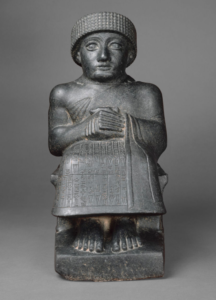
Period: Neo-Sumerian
Date: ca. 2090 B.C.
Place: Mesopotamia
Classification: Stone-sculpture-inscribed
The work from a visual perspective tells of an important and revered subject. The subject in the statues is Gudea, a ruler of the state of Lagash. The statue demonstrates a very sophisticated level of craftsmanship for the time and even today. The inscription details the story of Gudea, and how the statue is dedicated to honor the Gods/goddesses by being placed in a temple. Each of the very fine detailing of stone, form the hat, to the fingers/toes and the inscription is telling of the value of this particular artwork. This is almost an offering to the Gods, as the art is sought to represent divinity and the craft something more than the natural.
EGYPT
For ancient Egyptians, the ideal pharaoh was a man in his young adulthood and in the prime of his life however, physical reality often tended to be less important as old men, women, or even babies who have the title of pharaoh could be viewed in this very ideal form. Therefore, the visual image especially portrayed in artworks becomes a relevant part of devotion. The representation of of the female Hatshepsut shows exactly that. The inscriptions for her depicted her with masculine and feminine grammar even though it states she is a woman.
This statue was one that stood in the grand doorway on the upper terrace of Hatshepsut’s temple.

Period: New Kingdom
Date: ca. 1479-1459 B.C.
Place: Upper Egypt
Greece
Ancient Greece was probably one of the more widely recognized civilizations for their devotion to the supernatural, as they worshipped multiple Gods, each with a distinct character and quality. The Hellenists, like many ancient civilizations used there Gods as a way for making sense of the chaos in the world, and form an origin for human life.
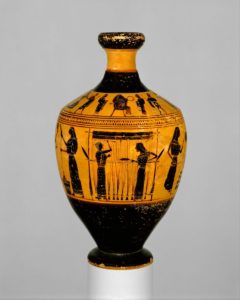
The most intriguing aspect of devotion in my perspective is that, the Greeks were able to form devotion through the mundane. In a sense incorporating religion and devotion into their everyday life, so much so that they are constantly reminded of it in every part of their day. Below is a simple vase depicting the story Perseus being sent to obtain the head of Medusa by King Polydektes.
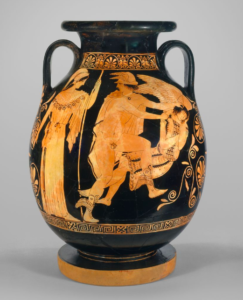
Period: Classical
Date: 450-440 B.C.
Place: Attic Greece
Classification: Vases
ROME
The ancient Roman era gives a different portrayal in devotion. The deities become dramatically similar in physiology to human beings. The devotion though still to a deity, shifts to the ideal image of human beings. The musculature and bone structure become highly emphasized for the ancient Romans. In a sense, this marks the beginning of a human superiority complex, and devotion starts to become self-centered. Because artists were able to portray the human body so keenly, the devotion toward the “human” becomes even more stronger. The athlete’s body was highly idealized and emphasized during this time.
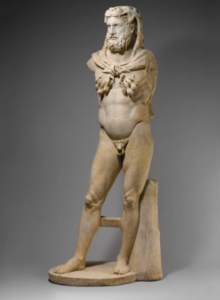
Name: Marble Statue of Bearded Hercules
Period: Early Imperial, Flavian
Date: 68-98 AD
Classification: Stone sculpture
RENAISSANCE
During the time of Renaissance, devotion becomes more focused and organized, as Christianity starts to take root among the people. People looked to a man named Jesus Christ as their savior. Because of Jesus’ narrative, paintings came of real value and emotion, like all other arts discussed. Jesus’ story became a center of focus, as it was so painful, touching and moving. Every aspect of Christ’s life was poured out into paintings. Especially, his climatic moments on Earth, were emphasized. The last supper became a symbolic element of the church to come together in communion and join the community in a union even after the leader’s death. The painting of the last supper became an emblem for community and worship.

Name: Last Supper
Date: 1325-30
Place: Italy
Classification: Painting
Annotated Bibliography
Ziegler, Joanna E. “Michelangelo and the Medieval Pietà: The Sculpture of Devotion or the Art of Sculpture?” Jstor, 1995, www-jstor-org.ez-proxy.brooklyn.cuny.edu/stable/pdf/767122.pdf.
This article focuses on how reacting to Flemish models Michelangelo remained consistent in his views of art. He radically redefined the enterprise of the sculpture and sculpture making and also art itself. He did so by making the sculptures inviolable (due to the change of material from wood to marble) and resistant to the physical transformations. I particularly took interest in this article because it was seen that the Flemish works have been associated with devotion and in ritualistic proceedings. This transformation in art as a consequence of Michelangelo explores how devotion becomes tested when art transforms.
“IWonder – Why Does the Art of Ancient Greece Still Shape Our World?” BBC News, BBC,2017www.bbc.com/timelines/z99tn39.
This research site goes into the specific of Greek art in chronological time while incorporating with its history. And we see, that Greek art often becomes a reminder for future generations about previous generations, it was a way of carrying down legacies. This is why art is important to the Greeks. Ancient art especially carries down the traditions of ancient Greek people, and allowing them to overwhelmingly present in everything gives a constant reminder to Greeks about who they are and who they were.
“Renaissance Art.” History.com, A&E Television Networks, 1 Jan. 2018, www.history.com/topics/renaissance/renaissance-art.
This website really helped to give a full understanding of Renaissance art and especially why it was important in Christianity. This helps draw the importance of Christ in almost all of Renaissance paintings and other artworks. The role serves a bigger purpose to unite the Christian community.
“Hatshepsut.” The Met’s Heilbrunn Timeline of Art History, 2010, www.metmuseum.org/art/collection/search/544446.
This website explores why gender was not an issue in Egyptian art work as their idealized figure always remained universal in all of the artworks. This becomes an important aspect in devotion as the role or title of pharaoh was to be devoted to rather than the individual identity.
NĂSTĂSOIU, DRAGOŞ GH. .. “Patterns of Devotion and Traces of Art.” Umeni / Art, vol. 64, no. 1, Jan. 2016, pp. 29–43. EBSCOhost,ezproxy.brooklyn.cuny.edu:2048/login?url=http://search.ebscohost.com/login.aspx?direct=true&db=aft&AN=114579735&site=ehost-live
The article provides an analysis of art history and patterns of devotion by referring to the pilgrimage of Queen Elizabeth Piast to Marburg, Cologne, and Aachen, Germany in 1357. Following the journey, the reader becomes convinced that there is infact a connection between art and devotion and two are inseparable.

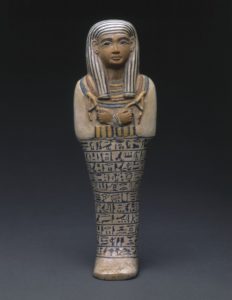
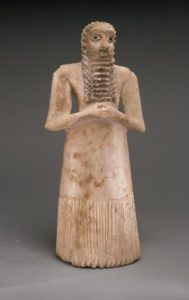 Artist: N/A
Title: Standing Male Worshiper
Date: 2900–2600 B.C.
Museum: The Metropolitan Museum of Art
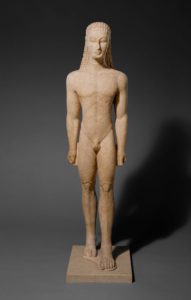
As time began to progress so the idea of humanism began to form and the shift from making art that focused on deities and worshiping them to making art that worshiped humanity and focused on the ideal human body. An example of an artwork that showed the start of the transition from focus on deities to a focus on humans is the Statue of Kouros. Unlike the Standing Male Worshiper which had almost no detail on the human body, the Statue of Kouros focuses soley on the human body. It is a representation of a young nude male. The artist of this sculpture adds small but noticeable details such as the outlining of the mans abs and chest. Another faint but drastic difference between the two sculptures is the sense of movement that can be seen in the legs of the Statue of Kouros. As seen in the photograph below, the left leg of the statue strides forward giving the sculpture a feeling of movement.
Artist: N/A
Title: Standing Male Worshiper
Date: 2900–2600 B.C.
Museum: The Metropolitan Museum of Art
As time began to progress so the idea of humanism began to form and the shift from making art that focused on deities and worshiping them to making art that worshiped humanity and focused on the ideal human body. An example of an artwork that showed the start of the transition from focus on deities to a focus on humans is the Statue of Kouros. Unlike the Standing Male Worshiper which had almost no detail on the human body, the Statue of Kouros focuses soley on the human body. It is a representation of a young nude male. The artist of this sculpture adds small but noticeable details such as the outlining of the mans abs and chest. Another faint but drastic difference between the two sculptures is the sense of movement that can be seen in the legs of the Statue of Kouros. As seen in the photograph below, the left leg of the statue strides forward giving the sculpture a feeling of movement.
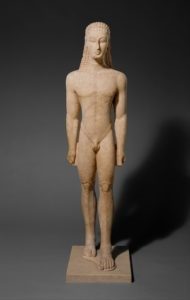 .
Artist: N/A
Title: Statue of Kouros
Date: 600 BCE
Museum: The Metropolitan Museum of Art
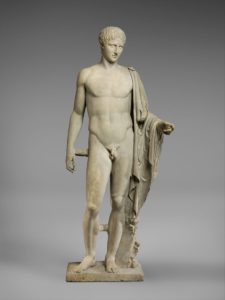
As more time passed the humanism movement became larger and lead to much more drastic changes in the art world. An example of a artwork that shows drastic a drastic change due to the humanism movement is the statue of Polykleitos. Similar to the statue of Kouros, the Doryphoros has a sense of movement but different to the Kouros, the Doryphoros has no symmetry. Instead the statue of Polykleitos has contrapposto. Contrapposto is the use of counter balancing to form "an asymmetrical arrangement of the human figure in which the line of the arms and shoulders contrasts with while balancing those of the hips and leg."(Google definition).By giving the statue contrapposto it the artist was able to show that the statue is suppose to represent a person walking.
.
Artist: N/A
Title: Statue of Kouros
Date: 600 BCE
Museum: The Metropolitan Museum of Art
As more time passed the humanism movement became larger and lead to much more drastic changes in the art world. An example of a artwork that shows drastic a drastic change due to the humanism movement is the statue of Polykleitos. Similar to the statue of Kouros, the Doryphoros has a sense of movement but different to the Kouros, the Doryphoros has no symmetry. Instead the statue of Polykleitos has contrapposto. Contrapposto is the use of counter balancing to form "an asymmetrical arrangement of the human figure in which the line of the arms and shoulders contrasts with while balancing those of the hips and leg."(Google definition).By giving the statue contrapposto it the artist was able to show that the statue is suppose to represent a person walking.
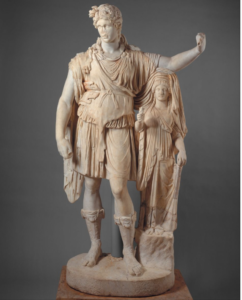
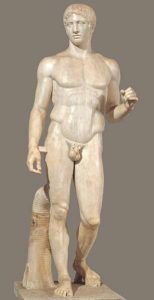 Artist: Polykleitos
Title: Doryphoros (Roman copy)
Date: 450-440 BCE
Museum: Museo Archaeologico Nazionale (Naples)
Artist: Polykleitos
Title: Doryphoros (Roman copy)
Date: 450-440 BCE
Museum: Museo Archaeologico Nazionale (Naples)
 Our first piece of ancient Egyptian hieroglyphics that we’ll look at is the Rosetta Stone. The Rosetta stone is the most well-known reason of why scholars can understand hieroglyphics in today’s modern world. It had writing in hieroglyphics and other languages to translate what was being written for all those people who couldn’t read hieroglyphics.
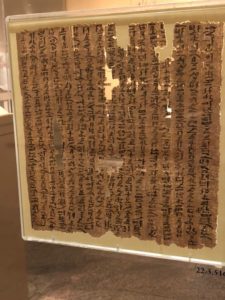 This piece of papyrus has hieroglyphics on it since that was the only form of writing that was available. There are more than 800 used hieroglyphics, but the most common are the twenty-four that are used to sound out words (like the English letters).
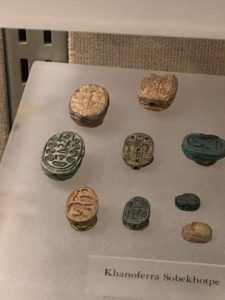 Next we are going to look at the amulets. These were put on jewelry, put around the house to beautify the dwelling, or buried with a mummy to have positive energy. Many Egyptians carried them around as a form of good luck and to bring positive energy. Some of the amulets had writing on it, hieroglyphics, to write exactly what energy they wanted the amulets to bring them. They were the perfect thing to carry around because of their size, they were convenient.
 The next thing we’ll look at is “Mummy Mask of a Woman with a Jeweled Garland”. THis was a mask placed over the mummy before it was placed in the tomb. There are paintings all around it to tell the story of the person in the mummy, to bring good energy to the persons transition to the afterlife, and to beautify the mummy so that the person is honored. Within the beautiful painting there are hieroglyphics. This is done to explain some of the painting, to give some positive words, and to identify the person within the mummy.
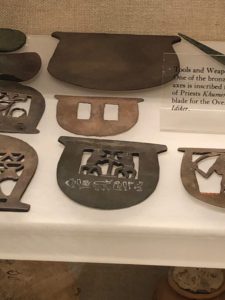 The last piece we are going to look at are these weapons. These were used by the Egyptians in battle. The curved edge was sharp and was a knife to fight the enemies. The hieroglyphics were engraved onto these items to give the fighter good luck in battle, and to mark who’s weapon is whoms. Each hieroglyph can be an entire word so even though there are about ten hieroglyphics on the piece it could say numerous things.

 Reload document
  Open in new tab